
Pitcher Plants: Complete Guide to Growing, Care, and Species
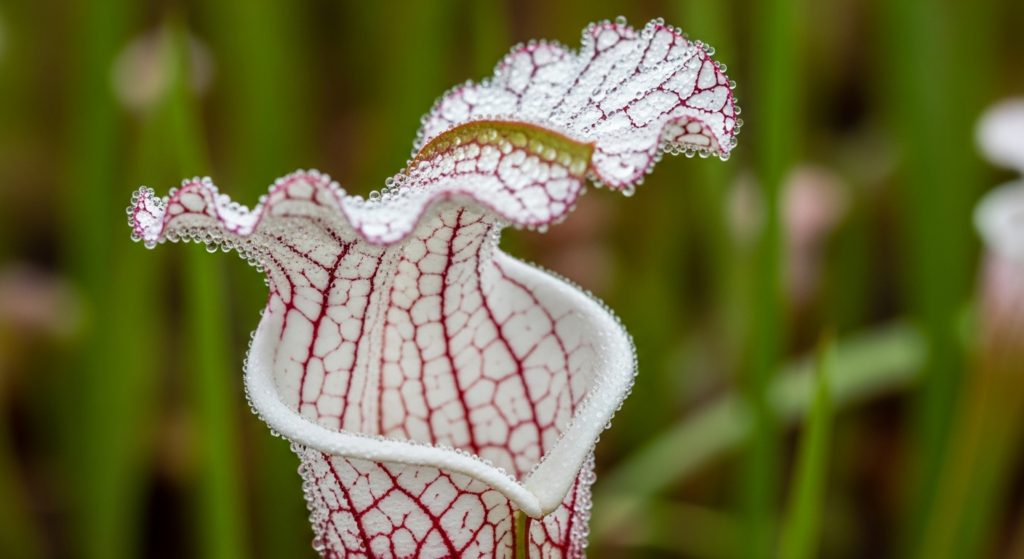
A single Sarracenia purpurea can trap and digest thousands of insects in a single growing season — not dozens, not hundreds, thousands. My abuela's plant sat on a windowsill in Puerto Rico for years, and I thought it was just a weird-looking succulent until I watched a wasp disappear into one of its red-veined cups and never come back. That was the moment I understood what a pitcher plant actually is: a predator disguised as a flower pot.
This guide covers everything you need to grow carnivorous pitcher plants successfully — whether you're eyeing a compact Sarracenia for your backyard bog or a sprawling tropical Nepenthes dangling from a hanging basket in your living room. I'll be direct about what kills these plants (spoiler: it's usually the water) and honest about which species are genuinely manageable for beginners.
In This Guide
- What Are Pitcher Plants and Why They Fascinate Growers
- Light, Temperature, and Dormancy: The Make-or-Break Fundamentals
- Water: The Silent Killer and How to Get It Right
- Soil, Repotting, and Container Choices
- Feeding, Fertilizer, and the Digestion Myth
- Common Problems: Pests, Disease, and Why Your Plant Is Dying
- Propagation and Growing from Seed
- Pitcher Plants as Houseplants: Realistic Expectations
What Are Pitcher Plants and Why They Fascinate Growers
Most plants evolved to be eaten. Pitcher plants flipped the script. They grow in soils so stripped of nitrogen — bogs, fens, coastal savannas — that pulling nutrients from the ground barely works. So they pull them from insects instead. That evolutionary pressure produced some of the most structurally complex leaves in the plant kingdom.
The Two Main Types: Tropical Nepenthes vs. American Sarracenia
When people say "pitcher plant," they usually mean one of two completely different genera. Sarracenia are the American pitcher plants — eight species native to the eastern United States and one extending into Canada, all temperate, all dormant in winter. Picture Sarracenia leucophylla, the white-topped pitcher plant: crimson veins spiderwebbing across a pale hood that flares open like a cobra spreading its hood. It looks like something a florist designed. It wasn't.
Nepenthes are the tropical pitcher plants, sometimes called monkey cups because monkeys have been observed drinking rainwater from their pitchers. Native to Southeast Asia, Madagascar, and parts of Australia, they're sprawling vines that dangle their traps on curling tendrils — each pitcher hanging like a lantern from a green cord. A mature Nepenthes rajah can produce pitchers large enough to hold two liters of digestive fluid. Not exaggeration. Documented biology.
Both genera share the carnivorous strategy but almost nothing else in terms of care. Treating them the same is one of the fastest ways to kill one of them.
How Pitcher Plants Actually Trap and Digest Prey
The pitcher itself is a modified leaf. The rim — called the peristome — is slick with nectar and often brightly colored to lure insects close. Once a fly or ant steps onto that rim, the surface offers almost no grip. It falls. Inside the pitcher, downward-pointing hairs and a pool of digestive fluid do the rest. The fluid contains enzymes that dissolve soft tissue over days. What the plant absorbs is mostly nitrogen and phosphorus — the exact nutrients its soil can't provide.
Some pitchers also host inquilines: mosquito larvae, mites, or bacteria that live inside the fluid and help break down prey. The plant and its residents have a working arrangement. Worth pausing on — a carnivorous plant with its own miniature internal ecosystem, like a bog compressed into a cup.
Natural Habitats and Why That Matters for Your Care
Sarracenia grow in nutrient-poor, waterlogged, acidic bogs along the eastern US coastal plain. Nepenthes split into two broad groups based on elevation: lowland Nepenthes thrive in hot, humid jungle floors below 1,000 meters, while highland Nepenthes grow in cool, misty mountain forests above 1,500 meters. Those habitats tell you everything about what these plants need from you.
The water draining through a North Carolina bog is naturally mineral-poor, filtered through sand and peat over decades. The water reaching a highland Nepenthes in Borneo is essentially rain — pure, cold, carrying almost nothing dissolved in it. Replicate those conditions and your plant thrives. Ignore them and you'll wonder why the pitchers keep collapsing.
> DID YOU KNOW: The genus Sarracenia was named after Michel Sarrazin, a French-Canadian physician who sent specimens to Europe in the early 1700s. It's one of the oldest documented carnivorous plant genera in Western botany. Learn more about carnivorous plant evolution at the Botanical Society of America.
Light, Temperature, and Dormancy: The Make-or-Break Fundamentals
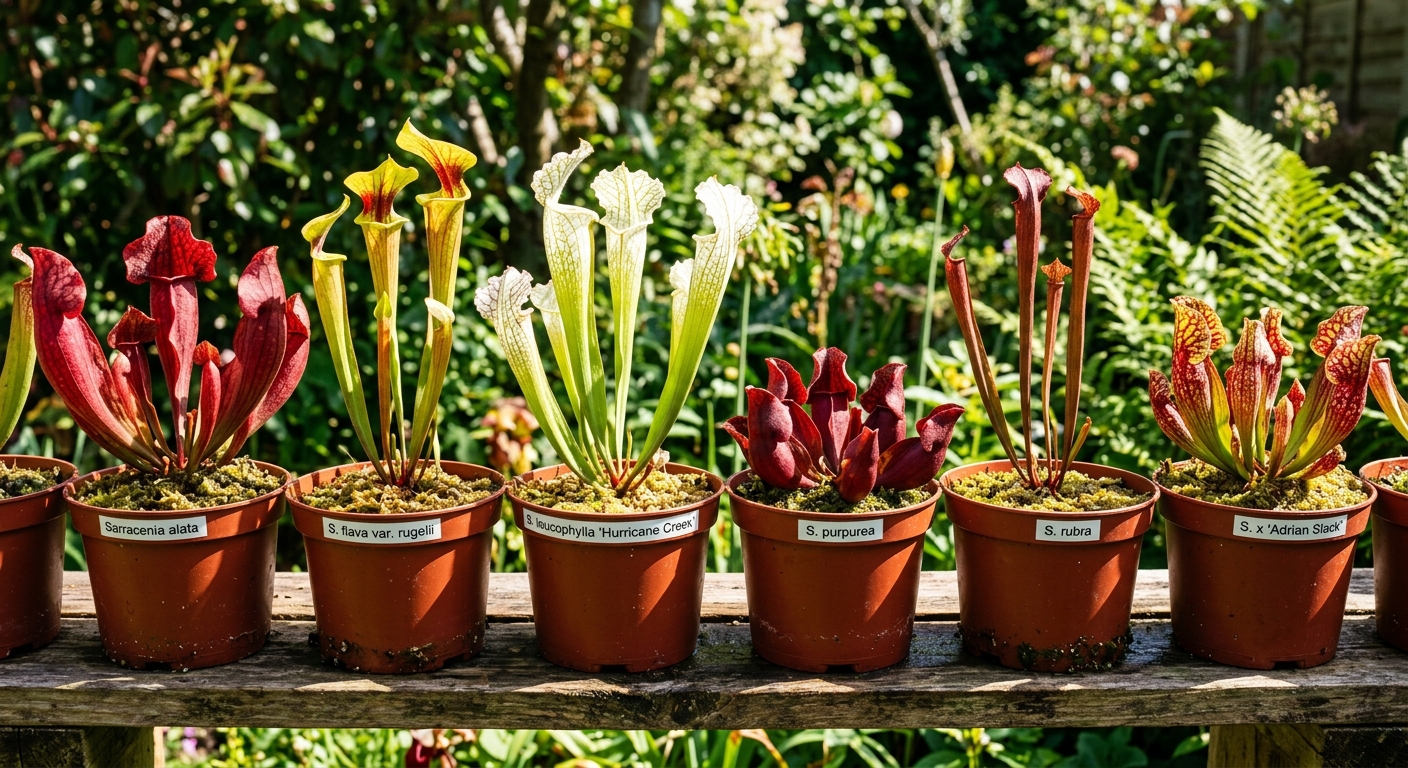
Get light and temperature wrong and no amount of correct watering saves your pitcher plant. These aren't forgiving plants when it comes to their core environmental needs.
Sun Requirements by Species Type
Sarracenia are sun addicts. In the wild, they grow in open bogs with no canopy overhead — full sun, six to eight hours minimum, ideally more. A Sarracenia sitting in a bright window indoors is probably getting half what it needs. The pitchers grow leggy and pale, stretching toward the glass like they're trying to escape. Put them outside in summer (USDA Zones 6–9 are ideal for most species) and watch them transform. The traps deepen in color, the hoods flare wider, and the plant actually starts catching things.
Nepenthes split again on light. Lowland species like N. ampullaria or N. mirabilis handle bright indirect light well — the kind that falls through a broken forest canopy, dappled and warm. Highland species like N. villosa or N. lowii prefer similar intensities but cooler air. Direct midday sun scorches both.
Winter Dormancy for Temperate Pitcher Plants
Here's where most beginners go wrong. Sarracenia are temperate plants. They evolved with cold winters, and they need them. When temperatures drop in autumn, the plant pulls resources from its pitchers — which die back and blacken, which is normal — stores energy in its rhizome, and shuts down. If you keep a Sarracenia warm all winter under grow lights, you're not being kind. You're slowly draining a battery with no way to recharge it.
Dormancy runs roughly November through February for most species. The plant needs temperatures between 35°F and 50°F (1–10°C). An unheated garage, a cold greenhouse, or even a refrigerator works. Keep the soil barely moist — not wet, not bone dry. Then bring it back into full sun in March and watch it wake up like it's been waiting all winter to get back to work.
I killed my second Sarracenia flava by overwintering it on a heat mat. I thought I was helping. The rhizome rotted by January.
Tropical Pitcher Plants and Year-Round Heat
Nepenthes don't do dormancy. Lowland species want 75–90°F (24–32°C) days with nights no cooler than 65°F (18°C). Highland species are trickier — they need that nighttime temperature drop to 50–60°F (10–15°C) even when days are warm. That 15–20°F swing is what triggers pitcher production in many highland species. Without it, the plant grows fine but produces few traps. It's the difference between a healthy plant and a spectacular one.
> WARNING: Never let a Sarracenia skip dormancy two winters in a row. One skipped winter weakens the plant. Two consecutive skipped winters often kills it. The rhizome runs out of stored energy with no recovery period.
Water: The Silent Killer and How to Get It Right
If I had to name the single thing that kills more pitcher plants than anything else, it's tap water. Not underwatering, not too much shade. Tap water. Every time.
Why Tap Water Fails and What to Use Instead
Tap water carries dissolved minerals — calcium, magnesium, chlorine, fluoride — that are fine for most garden plants and actively harmful for carnivorous ones. Pitcher plants evolved in oligotrophic (mineral-poor) environments. Their roots can't handle buildup. The technical ceiling is a total dissolved solids (TDS) reading of 50 parts per million or below. Most US tap water sits between 100 and 400 ppm. Some municipal supplies run higher.
Your options, in order of reliability: rainwater collected from a clean roof, reverse osmosis (RO) water from a home filter or grocery store machine, or distilled water from the store. I use RO water for everything in my Brooklyn grow tent — a 100-gallon-per-day membrane filter that cost about $150 and has paid for itself a dozen times over in plants I haven't killed.
Distilled works perfectly. It's just slower to collect and more expensive at scale. One or two plants? A gallon of distilled from the store is the simplest answer.
Humidity, Watering Frequency, and Soil Moisture
Sarracenia are bog plants. They want their roots wet, not damp — tray watering is the standard method. Sit the pot in a tray with an inch or two of pure water at all times during the growing season. The plant drinks from the bottom. In winter dormancy, drain the tray and keep the soil just barely moist.
Humidity matters less for Sarracenia than for Nepenthes. Most Sarracenia grow fine in ambient outdoor humidity as long as soil moisture is correct. Nepenthes are different. Lowland species want 70–90% relative humidity. Below 50% and the pitchers dry out, shrivel, and stop filling with fluid — they look like deflated balloons, which is exactly what they are. A basic hygrometer tells you where you stand.
Lowland vs. Highland Nepenthes Water Needs
Lowland Nepenthes tolerate wet conditions at the root zone — their native swamp-edge habitats flood seasonally. You can keep them in the tray method or water them heavily and let them drain. Highland Nepenthes are more sensitive. Their montane soils drain fast. Sitting in a water tray for extended periods rots the roots. Water them thoroughly, let the medium approach dryness at the surface, then water again. Think of highland Nepenthes roots like a sponge you want damp but never submerged — squeeze it, let it breathe, squeeze it again.
Soil, Repotting, and Container Choices

The myth that pitcher plants need "special" soil is half true. They don't need anything expensive or exotic — they need soil that mimics their native habitat: low nutrients, good moisture retention, decent aeration.
Substrate Mixes for Sarracenia vs. Nepenthes
For Sarracenia, the classic mix is peat moss and perlite at a 1:1 ratio by volume. That's it. No fertilizer, no garden soil, no compost. Peat holds moisture and stays acidic. Perlite keeps it from compacting into an airless brick. Some growers use long-fiber sphagnum moss instead of peat — it works equally well and lasts longer before breaking down.
Nepenthes want a mix that drains faster. A common formula is 60% long-fiber sphagnum, 30% perlite, and 10% orchid bark. The bark improves drainage and adds structure. Lowland species tolerate wetter mixes. Highland species want the faster-draining end — err toward more perlite if you're unsure.
Never use potting mix from a garden center. Those products contain fertilizer, often slow-release pellets that leach nutrients into the soil for months. For a pitcher plant, that's poison. Slow, invisible poison — the plant declines over weeks before you figure out what's happening.
When and How to Repot Without Shock
Repot Sarracenia during dormancy — late winter, just before new growth starts. The rhizome is dormant, roots are less active, and the plant handles disturbance better than it would mid-summer when it's actively pushing out pitchers. Shake off the old medium, inspect the rhizome for rot (firm and white-green is healthy; soft and brown means trouble), trim dead roots, and pot into fresh mix.
Nepenthes can be repotted year-round but prefer the transition during active growth. Move up one pot size at a time. Jumping from a 4-inch to a 10-inch pot floods the roots with too much wet medium and invites rot.
Container Types and Drainage Essentials
For Sarracenia, plastic pots outperform terra cotta. Terra cotta wicks moisture and concentrates minerals in the pot wall over time — the white crust you see on old clay pots is exactly the mineral buildup that damages these roots. Plastic retains moisture better and stays neutral. Drainage holes are non-negotiable.
Nepenthes do well in plastic or glazed ceramic. Some growers use hanging baskets lined with sphagnum for lowland species, which gives the roots excellent airflow. Whatever container you choose, drainage matters more than pot size.
| Feature | Sarracenia | Lowland Nepenthes | Highland Nepenthes |
|---|---|---|---|
| Light | Full sun (6–8 hrs) | Bright indirect | Bright indirect |
| Day temp | 70–90°F (21–32°C) | 75–90°F (24–32°C) | 65–80°F (18–27°C) |
| Night temp | 40–65°F (4–18°C) | 65–75°F (18–24°C) | 50–60°F (10–15°C) |
| Dormancy | Yes (Nov–Feb) | No | No |
| Watering method | Tray method | Tray or heavy watering | Water and drain |
| Humidity | 40–70% | 70–90% | 70–90% |
| Soil mix | Peat:perlite 1:1 | Sphagnum/perlite/bark | Sphagnum/perlite/bark |
| USDA outdoor zone | 6–9 (most species) | Not cold-hardy | Not cold-hardy |
Feeding, Fertilizer, and the Digestion Myth
People see a pitcher plant and immediately want to feed it. A fly, a cricket, maybe a bit of raw hamburger. The impulse makes sense — the plant is a predator, you want to watch it work. But feeding in captivity is more nuanced than most guides admit.
Do Pitcher Plants Need You to Feed Them?
Outdoors, no. A Sarracenia sitting in your garden from May through September catches more insects than you could ever hand-feed it. California Carnivores notes that a healthy American pitcher plant can trap thousands of insects in a season — ants, flies, wasps, the whole parade. The plant handles its own nutrition.
Indoors under lights, the situation changes. Fewer insects wander into a grow tent. If your plant is growing in a sealed indoor setup with no natural prey, supplemental feeding every two to four weeks during the growing season helps. Drop a freeze-dried bloodworm or a small cricket into one or two pitchers. Not all of them — modest supplementation, not a feast.
Fertilizer Mistakes That Kill Pitcher Plants
Standard fertilizer — the kind you'd use on tomatoes or houseplants — burns a pitcher plant's roots. These plants evolved in nutrient-poor soils. Their root systems are adapted for near-zero mineral input. A dose of 10-10-10 fertilizer that would perk up a rose causes root necrosis in a Sarracenia within weeks. I've seen it happen. The leaves yellow from the base upward, the rhizome softens, and by the time you realize what went wrong it's usually too late.
If you want to fertilize, use a highly diluted foliar spray — MaxSea at 1/4 teaspoon per gallon of pure water, sprayed into the pitchers rather than the soil, is a method some experienced growers use. I've tried it on a few of my Nepenthes with modest results. It's not necessary if the plant is catching prey. It's a tool for plants in very low-light, low-prey indoor setups.
Natural Feeding vs. Supplementation in Captivity
Here's where I disagree with most beginner guides: they either say "never feed" or "feed constantly." Neither is right. Think of supplemental feeding the way you'd think of a vitamin — useful when the diet is genuinely lacking, pointless or harmful in excess. A pitcher already half full of decomposing prey doesn't need more. A pitcher that's been empty for two months in a sealed grow room probably does.
> TIP: If you're feeding freeze-dried insects, wet them slightly before dropping them into the pitcher. Dry prey absorbs the digestive fluid before the plant can use it, reducing the nutritional yield.
Common Problems: Pests, Disease, and Why Your Plant Is Dying
Pitcher plants are resilient once established but fragile when stressed. Most problems trace back to one of three sources: wrong water, wrong humidity, or wrong air circulation.
Recognizing and Treating Fungal and Bacterial Issues
Botrytis (gray mold) is the most common fungal problem in humid grow setups. It looks like gray fuzz spreading across dying pitchers or leaf bases — soft, powdery, spreading fast in stagnant air. The fix is airflow. A small fan circulating air in your grow space cuts Botrytis risk dramatically. Remove affected tissue immediately with clean scissors, and if the infection is widespread, a copper-based fungicide applied carefully to the growing medium (not the pitchers) can help.
Bacterial rot usually starts at the rhizome and works upward. You'll smell it before you see it — a sour, swampy odor rising from the soil, different from the normal earthy smell of peat. Pull the plant, cut away soft brown tissue until you reach firm growth, dust the cut with powdered cinnamon (a mild antifungal), and repot into fresh medium. Not a guaranteed save, but it works more often than you'd think.
Pest Management Without Harming the Plant
Aphids are the most common pest on Sarracenia, usually targeting new growth in spring. They cluster at the base of emerging pitchers and on flower stalks, a dense green mass of them if you look close. A strong blast of pure water knocks most off. For persistent infestations, insecticidal soap diluted to half strength works — but rinse the plant well afterward. Avoid systemic pesticides. A plant that absorbs pesticide through its roots and then digests insects creates a feedback loop that's hard to predict.
Fungus gnats love the wet, peaty soil of bog plants. Their larvae damage roots. Yellow sticky traps catch adults. A layer of dry sand on the soil surface discourages egg-laying. Both methods together usually solve the problem within a few weeks.
Pitcher Blackening, Leaf Drop, and What Causes Them
Blackening pitchers alarm every new grower. Most of the time? Normal. Old pitchers die back as new ones form, and Sarracenia pitchers naturally blacken and collapse in autumn as the plant heads into dormancy. That's not a problem. That's the plant working correctly.
Blackening that starts at the pitcher mouth and moves downward during the growing season is different. That pattern usually points to tap water mineral burn, low humidity causing pitcher fluid to evaporate and concentrate, or a fungal infection working down from the lid. Check your water source first. It's the answer 70% of the time.
Propagation and Growing from Seed
Growing pitcher plants from seed is slow, satisfying, and genuinely one of the more meditative projects I've taken on in twelve years of growing carnivorous plants. It's also where a lot of growers get tripped up by skipping one critical step.
Seed Stratification and Germination Timing
Sarracenia seeds need cold stratification to germinate reliably. In the wild, seeds drop in autumn, sit through winter cold and wet, and germinate in spring. You replicate this by placing fresh seeds on damp sphagnum moss in a sealed bag and refrigerating them for 4–8 weeks at around 39°F (4°C). Skip stratification and germination rates drop dramatically — sometimes to near zero.
After stratification, surface-sow the seeds on a peat-perlite mix, keep them under bright light at room temperature, and maintain consistent moisture. Germination takes 2–6 weeks. Seedlings are tiny — like green threads with a dot at the end, barely visible against the dark peat. They need 2–3 years before they produce recognizable pitchers. Patience isn't optional here.
Division and Rhizome Propagation for Sarracenia
Division is the fastest way to multiply Sarracenia. During repotting in late winter, you'll often find the rhizome has branched into two or more growing points. Separate them with a clean, sharp knife — each division needs at least one healthy growing tip and some roots attached. Pot each division separately in fresh medium and treat it like a newly potted plant. Most divisions establish within one growing season and produce pitchers the same summer.
This is how I've expanded my collection from one inherited S. purpurea to the dozen or so Sarracenia I now grow across two grow tents. Division is reliable, free, and produces genetically identical plants.
Tissue Culture and Cuttings for Nepenthes
Nepenthes don't have rhizomes to divide. The standard propagation method is stem cuttings. Take a cutting with two to three nodes, remove the lower leaves, and stick the cut end into damp long-fiber sphagnum. Enclose the cutting in a humidity dome or clear plastic bag to maintain near-100% humidity while it roots. Rooting takes 6–12 weeks depending on the species. Lowland species root faster than highland ones as a general rule.
Seed propagation for Nepenthes is possible but requires a male and female plant in flower simultaneously — they're dioecious, meaning individual plants are either male or female, not both. Seeds also need to be sown fresh; they lose viability within weeks of harvest. For most hobbyists, cuttings are the practical answer.
Pitcher Plants as Houseplants: Realistic Expectations
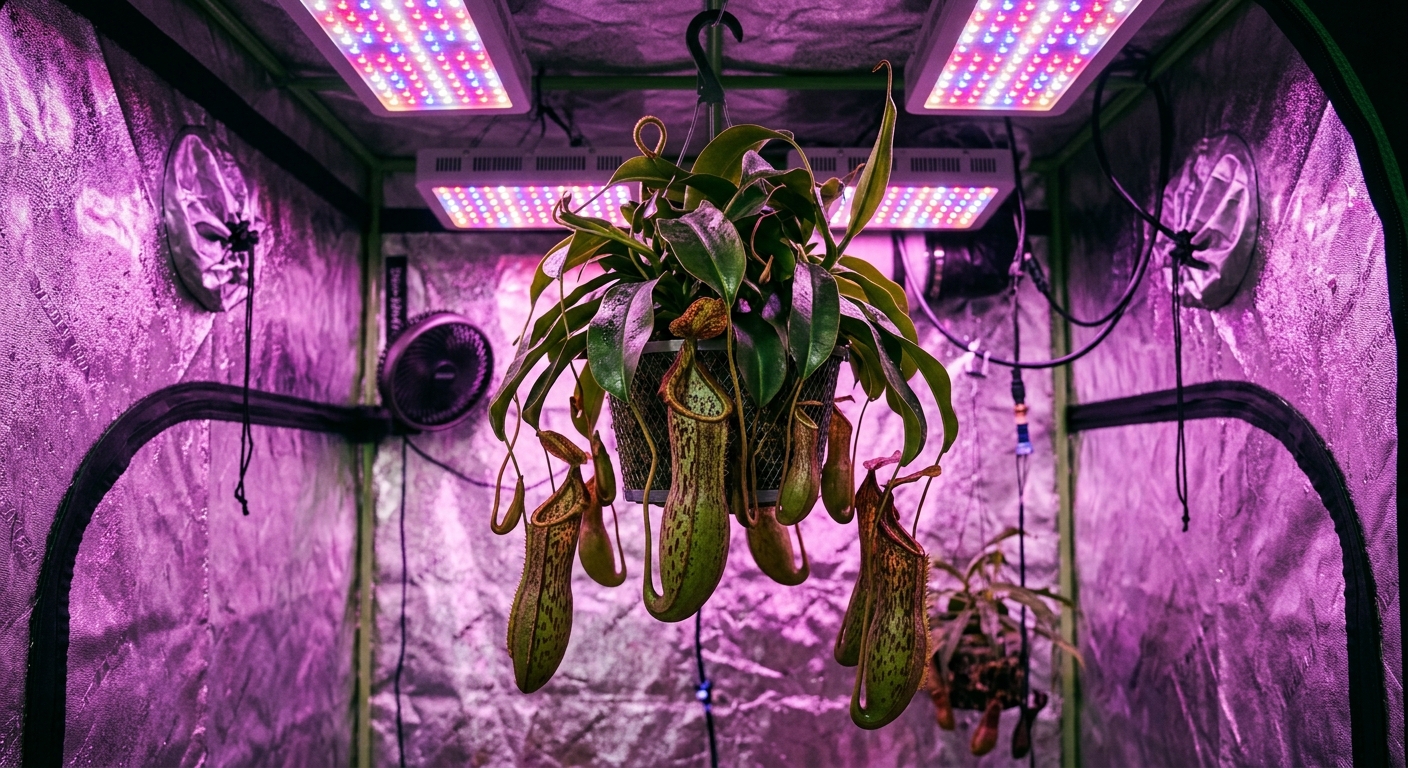
Here's the honest answer to the question every beginner asks: some pitcher plants make decent houseplants. Most don't. The ones that work indoors are the species that tolerate lower light, stable temperatures, and the humidity levels a normal apartment can actually provide.
Which Species Actually Survive Indoors
Lowland Nepenthes are the best candidates. N. ampullaria, N. mirabilis, and hybrid cultivars like N. x ventrata (a cross between N. ventricosa and N. alata) tolerate conditions that would stress most other carnivorous plants. No cold dormancy needed. Moderate humidity. Pitchers under grow lights without complaint.
Sarracenia are harder indoors because of the dormancy requirement and their need for intense light. You can grow them under high-output LED grow lights and refrigerate them in winter, but it's a real commitment — not a set-it-and-forget-it situation. The Cobra Lily (Darlingtonia californica) is not a beginner houseplant under any circumstances. It needs cold, moving water at its roots and cool temperatures year-round. I've tried it twice. Both plants died. I'm not trying again.
Growing Under Lights vs. Window Sills
A south-facing window in a Brooklyn apartment gets maybe four to five hours of direct sun in summer, less in winter. That's marginal for Sarracenia and adequate for lowland Nepenthes. My fire-escape light shelf handles my hardier Sarracenia from May through September — they go outside, get real sun, and come back in for winter dormancy in the fridge. The Nepenthes stay under a two-panel LED grow light set to a 14-hour photoperiod year-round.
For grow lights, full-spectrum LEDs in the 3000–6500K range work well. Position them 6–12 inches above the plant canopy. A cheap light meter or a smartphone app that reads lux tells you whether you're hitting the 2,000–5,000 lux range that lowland Nepenthes need.
Humidity Trays, Terrariums, and Setup Reality
A humidity tray — a shallow tray filled with pebbles and water, with the pot sitting above the waterline — raises local humidity by maybe 5–10%. Not enough for Nepenthes in a dry apartment. A small ultrasonic humidifier pointed at the plant cluster works better. A sealed terrarium works better still but creates airflow problems that invite mold.
The setup that actually works for me: a 4x2 grow tent with a small clip fan for circulation, an ultrasonic humidifier on a timer, and a TDS meter to check every batch of water before it touches a plant. Not glamorous. It's a corner of my bedroom that smells faintly of peat. But the plants are thriving, and that's the only metric that matters.
> KEY TAKEAWAY: Pitcher plant success comes down to three things done consistently: pure water under 50 ppm TDS, appropriate light for the species, and respecting dormancy for temperate types. Get those three right and most other problems become manageable.
Frequently Asked Questions About Pitcher Plants
How hard is it to keep a pitcher plant alive?
With the right water and light, Sarracenia are genuinely easy — among the most forgiving carnivorous plants available. Nepenthes vary by species. Lowland hybrids are manageable for beginners. Highland species require more controlled conditions and are better suited to experienced growers.
What water should I use for pitcher plants?
Rainwater, distilled water, or reverse osmosis water — all with a TDS reading below 50 ppm. Tap water contains minerals that accumulate in the soil and damage roots over time. This is the single most common cause of pitcher plant decline in cultivation.
Why are my pitcher plant pitchers turning black?
In autumn, blackening pitchers on Sarracenia are normal dormancy behavior. During the growing season, blackening that starts at the pitcher mouth usually signals tap water mineral burn, low humidity, or fungal infection. Check your water source first — it's the answer most of the time.
Are pitcher plants good houseplants?
Lowland Nepenthes hybrids like N. x ventrata are the most practical choice for indoor growing. They tolerate typical room temperatures, handle moderate humidity, and produce pitchers under grow lights. Sarracenia can be grown indoors but require a cold dormancy period and intense light — more commitment than most houseplant setups provide.
Do pitcher plants need to be fed insects?
Outdoors, no — they catch more than enough on their own. Indoors in a sealed grow setup with no natural prey, light supplemental feeding every two to four weeks during the growing season (a freeze-dried bloodworm or small cricket per pitcher) supports healthy growth. Never use standard fertilizer on the soil.
FAQ
How hard is it to keep a pitcher plant alive?
With the right water and light, Sarracenia are genuinely easy — among the most forgiving carnivorous plants. Lowland Nepenthes hybrids are also manageable for beginners. Highland Nepenthes require more controlled temperatures and humidity and suit more experienced growers.
What water should I use for pitcher plants?
Use rainwater, distilled water, or reverse osmosis water with a TDS reading below 50 ppm. Tap water contains dissolved minerals that accumulate in the soil and damage roots over time. This is the single most common cause of pitcher plant failure in home cultivation.
Why are my pitcher plant pitchers turning black?
In autumn, blackening pitchers on Sarracenia are normal — the plant is entering dormancy. During the growing season, blackening that starts at the pitcher mouth usually signals tap water mineral burn, low humidity, or fungal infection. Check your water source first.
Are pitcher plants good houseplants?
Lowland Nepenthes hybrids like N. x ventrata are the most practical indoor choice. They tolerate room temperatures and moderate humidity. Sarracenia can work indoors but need cold winter dormancy and intense light, which most home setups can't easily provide.
Do pitcher plants need to be fed insects?
Outdoors, no — they catch plenty on their own. Indoors in a sealed grow setup, light supplemental feeding every two to four weeks during the growing season helps. Use freeze-dried bloodworms or small crickets dropped into the pitchers. Never apply standard fertilizer to the soil.
